
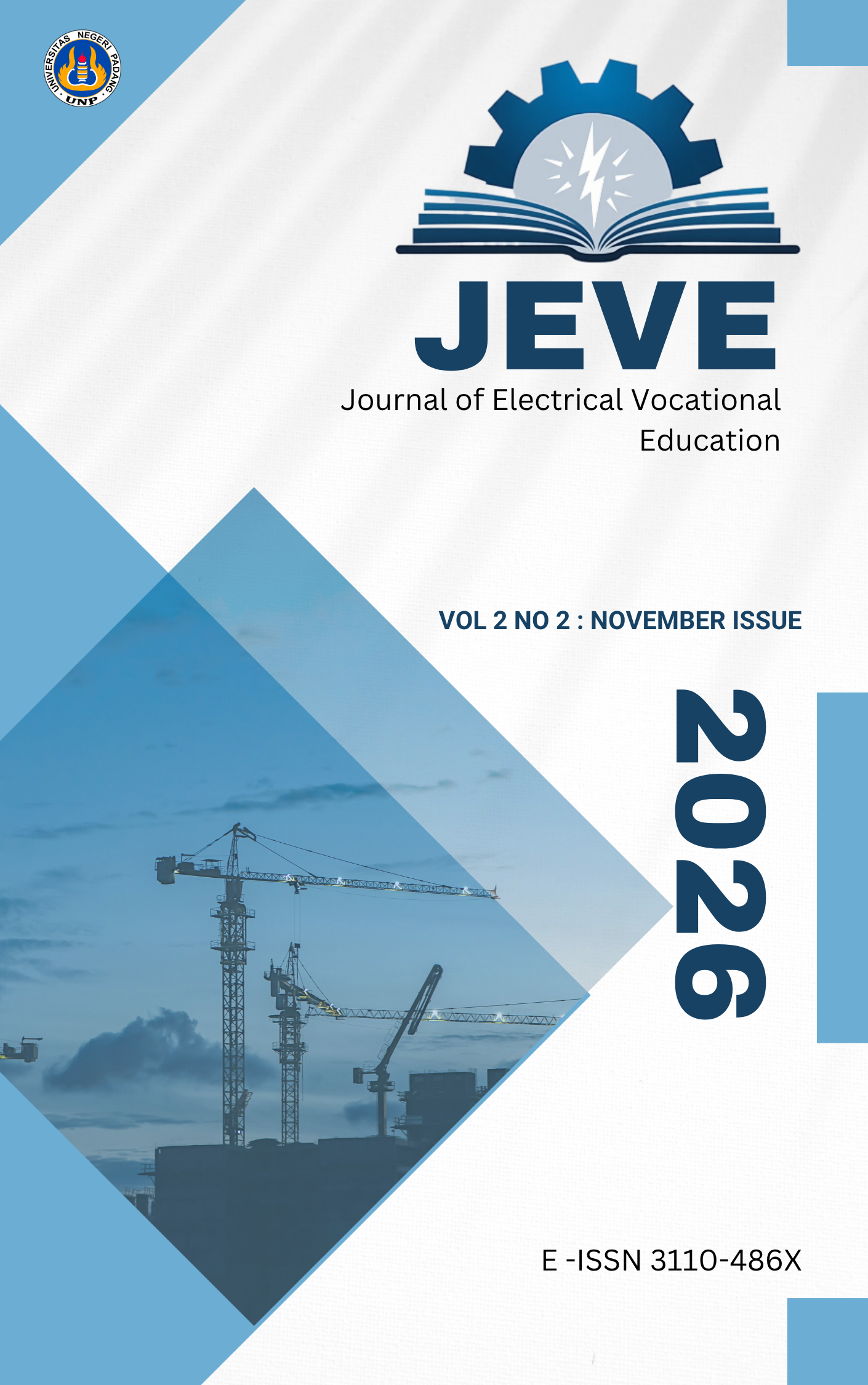

| Journal Title | Journal of Electrical Vocational Education |
| Accreditation | - |
| DOI | prefix 10.24036 by Crossref |
| Frequency | The journal will be publish twice(two issues per year: June and November) |
| ISSN | Online (3110-486X) |
| Editor in Chief | Assoc. Prof. Dr. Mukhlidi Muskhir, S.Pd., MT., Ph.D. |
| Publisher | Department of Electrical Engineering Universitas Negeri Padang |
| Indexing | Google Scholar | GARUDA |
Journal of Electrical Vocational Education (JEVE), e-ISSN 3110-486X is an open-access academic journal published by the Department of Electrical Engineering, Universitas Negeri Padang, Indonesia. As an platform, JEVE seeks to foster the exchange of knowledge and ideas by promoting the integration of electrical engineering studies and vocational education.
The journal is dedicated to publishing high-quality original research articles, case studies, and theoretical papers that explore various aspects of technical and vocational education. Areas of interest include, but are not limited to, curriculum innovation, instructional strategies, competency-based training, industry linkages, and the impact of digital transformation on teaching and learning in vocational and technical fields.
Template manuscript can be downloaded Here
Note: -
Current Issue
Vol. 2 No. 2 (2026): November Issue